Rust Blueprints Guide: Research Costs, Tech Tree & BP Wipes
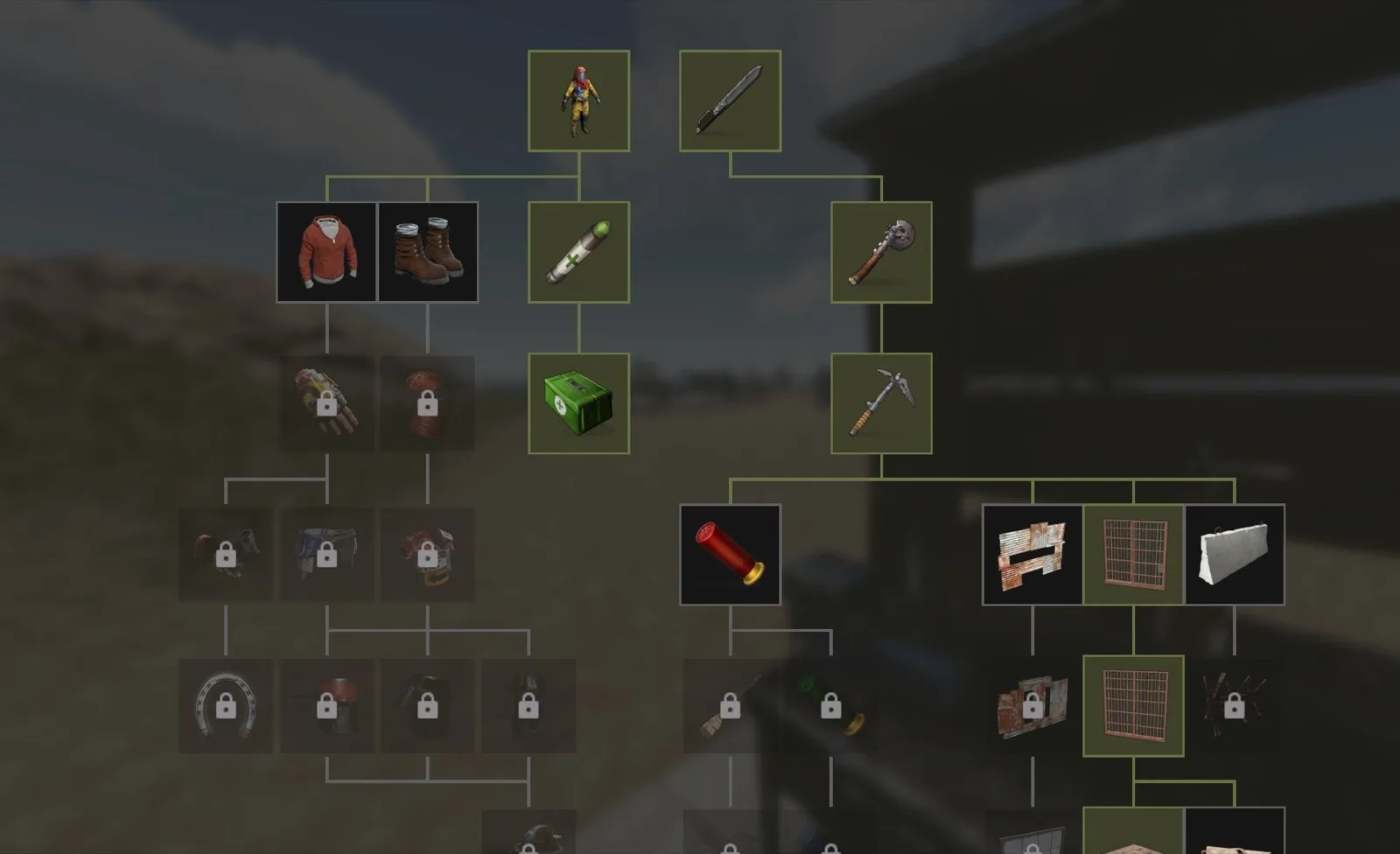
Quick answers first, because most people land here mid-wipe with a looted gun in their inventory. Researching an AK costs 120 scrap at a research table. Blueprints survive normal map wipes and only reset on a force wipe. And if you're holding the item, the research table is almost always cheaper than the tech tree. That's the skeleton. The rest of this guide is the meat: what blueprints actually are, what every research tier costs, when the tech tree beats the table, and what to unlock first so you're not the base still throwing spears on day three.
A blueprint, or BP, is permission to craft an item. Rust hides most gear behind them on purpose: finding a rifle on the ground lets you use that rifle, not print more. To craft it yourself you learn the BP first, and every path to learning one runs on scrap. That's why scrap is the real currency of progression, and why knowing these costs before you spend is worth more than any amount of farming.
Default Blueprints: What You Already Know
You don't start from zero. Of the 656 items in our item database, 324 are default blueprints, craftable from the moment you spawn with no research needed. That's your stone tools, bows, wooden and sheet metal doors, bags, basic building gear, and, crucially, all three workbenches and the Research Table itself. The progression backbone is free; it's the guns, meds, armor, and explosives that sit behind the paywall.
Everything else, roughly 350 items, has a research cost. Learn it once and it's yours for the wipe: unlocked BPs are permanent until a blueprint wipe, no matter how many times you die or lose your base.
The Research Table: How Researching Works
The Research Table is a default blueprint that costs 200 metal fragments and 20 scrap to craft at a Workbench 1. Can't afford one yet? Outpost has a public research table you can use for free, which is exactly how most solos bank their first big BP. Full stats live on the research table item page.
Using it is a sacrifice play. You drop the physical item into the table with the scrap cost, hit research, and the table destroys the item and teaches you its blueprint. That trade-off is the whole system: a looted Thompson in your hands is one gun, but a researched Thompson is every Thompson you'll ever have the components for.
Research costs aren't random. Almost every item in the game falls into one of four scrap tiers:
| Research cost | Items at this tier | Typical examples |
|---|---|---|
| 15 scrap | 90 items | Cheap deployables, basic clothing |
| 30 scrap | 105 items | Garage Door, Medical Syringe |
| 60 scrap | 77 items | Semi-Automatic Rifle, Satchel Charge, Hazmat Suit |
| 120 scrap | 15 items | Assault Rifle, C4, Rocket Launcher |
The 120 club is small and it's exactly the items you'd guess: the endgame guns and raiding explosives. Everything else is pocket change by mid-wipe, which is why the correct habit is to research nearly anything decent you loot and don't already know.
Tech Tree vs Research Table: When Each Is Cheaper
The tech tree is the other way to learn a BP: stand at a workbench, spend scrap node by node down a branch, no item required. Individual nodes are cheap, priced in the same 15/30/60/120 tiers, but you pay for every prerequisite on the path. That path cost is what decides which method wins, and the numbers are stark:
| Item | Research table | Full tech tree path | You save by researching |
|---|---|---|---|
| Assault Rifle | 120 | 780 | 660 |
| C4 (Timed Explosive Charge) | 120 | 720 | 600 |
| Rocket Launcher | 120 | 1,110 | 990 |
| Semi-Automatic Rifle | 60 | 930 | 870 |
| Satchel Charge | 60 | 510 | 450 |
| Garage Door | 30 | 240 | 210 |
| Medical Syringe | 30 | 90 | 60 |
Path totals assume a fresh tree; if you already own nodes on the way, the marginal cost drops. And at the other extreme, a few items like the Hazmat Suit cost the same either way (60 scrap), because they sit at the front of their branch.
So the rule I actually play by: research what you loot, tech-tree what you're building toward. A found SAR goes straight into the table, because 60 scrap versus 930 down the tree isn't a decision. But if nothing has dropped and I need meds and armor anyway, the tree wins, because those prerequisite nodes were things I wanted regardless. The tech tree guide breaks down the best branch order for each bench, starting with tier 1.
One more wrinkle: researching still respects workbench tiers. Of the researchable items, 125 sit at Workbench 1, 133 at Workbench 2, and 26 at Workbench 3. The benches themselves are default BPs, but they're not free to craft: WB1 runs 500 wood and 100 metal fragments, WB2 wants 500 fragments, 20 high quality metal, and 5 Basic Blueprint Fragments, and WB3 climbs to 1,000 fragments, 100 HQM, and 5 Advanced Blueprint Fragments. Those fragment items are loot you find, not something you research — and don't confuse them with the blueprint "fragments, pages and books" of Rust's pre-2018 progression system, which is long gone. Knowing a BP isn't the end of the bench relationship either: you still have to stand near a bench of the right tier to craft the item, and crafting near a higher-tier bench than required speeds the craft up.
Can You Share or Trade Blueprints?
No — and this shapes how groups play. A learned blueprint lives on your account for that server; there is no blueprint item you can drop, mail, or sell to a teammate in the current game. What you can trade is everything around the BP:
- chevron_rightTrade the item, not the knowledge. Hand a teammate your spare Thompson and 60 scrap and they can research it themselves. This is the standard way groups spread key BPs — one good loot drop becomes everyone's blueprint, one sacrificed copy at a time.
- chevron_rightCraft for each other. One player who knows the AK can arm the whole team. That's why the division-of-labor plan above works: the group doesn't need five AK blueprints, it needs one plus components.
- chevron_rightSell crafted output. Vending machines let BP-holders turn their unlocks into a scrap income — a syringe or armor shop near a busy road monetizes a 30-scrap research many times over.
The per-player rule cuts the other way too: joining an established group late still means researching your own tree, so keep your personal scrap priorities even when the group vault is deep. If you're playing across wipes, our blueprint tracker keeps a checklist of what you've unlocked and what's still missing.
What to Research First, by Playstyle
Scrap is finite and every wipe I watch someone burn theirs on furniture. Spend on a plan:
Solo or duo. Medical Syringe first; at 30 scrap it's the best value in the game and it wins you fights bandages lose. Then a real gun: research the first SAR or Thompson you loot rather than tech-treeing to one. Garage Door at 30 scrap hardens your base for almost nothing.
Small group. Same start, but split the load: one player banks the gun BPs, another takes meds and armor, and you push the WB2 branch together. A group's advantage is running multiple research lanes at once instead of everyone learning the same Thompson.
Raid-focused. Satchel Charge at 60 scrap is your first raiding tool, and notably it's a Workbench 1 item, so you can be cracking doors before anyone has a tier 2 down. From there it's the 120-scrap heavy hitters: C4, then Rocket Launcher, funded by a serious scrap farming routine, because the explosives themselves cost far more than their blueprints.
Whatever the lane, the meta-rule holds: never tech-tree deep to an item you're holding, and never research a cheap item that sits on a branch you're about to buy anyway.
Do Blueprints Wipe? The BP Wipe, Explained
Blueprints are tougher than your base. On a standard weekly or biweekly map wipe, the world resets, every base is deleted, and your blueprints survive: you respawn naked but with your whole researched tree intact, which is why veterans re-arm so fast on wipe day. Your BPs are tied to your account on that specific server, so a fresh server means a fresh tree regardless.
The reset that matters is the force wipe: first Thursday of every month, around 19:00 UTC, when Facepunch ships the monthly update. That one clears the map and every blueprint, server-wide, no opt-outs. When someone says "BP wipe," this is what they mean: the whole server back to default blueprints, nobody owning the AK, and the opening hours turning into a scrap race. Some community servers also run their own BP wipes on a schedule, so check before you commit an evening. The full breakdown of wipe types and timing is in the wipe guide, and your skins are never touched by any of it; those live in your Steam inventory, not on the server.
The practical read: early in a BP-wipe cycle, research aggressively, because every BP pays out for a full month. In the last days before a force wipe, stop banking blueprints you'll lose on Thursday and spend the scrap on gear you can actually use tonight.
Putting It Together
Blueprints are the progression system; everything else is fuel for it. Start from your 324 default BPs, get a Research Table down (or borrow Outpost's), and run the two-track rule: table for what you loot, tech tree for what you're chasing. Budget by the tiers, 15/30/60 for the everyday unlocks and 120 for the endgame four, and remember the tree charges up to ten times the table price for the same deep item. Feed it all with a proper scrap loop, keep one eye on the force wipe date, and you'll be crafting AKs while your neighbors are still paying tolls down a tech tree branch.
Frequently Asked Questions
Do blueprints wipe in Rust?expand_more
Only on a blueprint wipe. Normal weekly or biweekly map wipes reset the world and your base but leave every researched blueprint intact. The monthly force wipe, first Thursday of the month around 19:00 UTC, resets both the map and all blueprints on every server. Blueprints are also per-server, so joining a new server means starting the tree from scratch there.
How much scrap does it cost to research an AK in Rust?expand_more
120 scrap at a research table, if you have an Assault Rifle in hand to sacrifice. Unlocking it through the tech tree instead costs 780 scrap down a fresh Workbench 3 branch, so researching a looted AK saves you 660 scrap.
What is a BP wipe?expand_more
A BP wipe is a reset of every blueprint players have researched, sending the whole server back to default blueprints only. Facepunch forces one alongside the map reset on the monthly first-Thursday update, and some community servers schedule extra ones. A plain map wipe is not a BP wipe; it deletes bases but keeps your unlocks.
How do you research items in Rust?expand_more
Craft a Research Table (200 metal fragments and 20 scrap at a Workbench 1) or use the free one at Outpost. Put the item you want to learn into the table with its scrap cost, usually 15, 30, 60, or 120 depending on the item, and hit research. The table destroys that copy of the item and permanently teaches you its blueprint for the rest of the wipe.
Is the research table cheaper than the tech tree?expand_more
Per item, almost always, because the tech tree makes you buy every prerequisite node on the branch while the table charges one flat cost. The catch is the table needs the physical item, which gets destroyed. Tech-tree when you don't have the item or want the whole branch anyway; research everything good you loot.
How do you get blueprints in Rust?expand_more
Three routes. You start with 324 default blueprints the moment you spawn. For everything else you either sacrifice a copy of the item plus scrap at a research table, or buy your way down the workbench tech tree node by node with scrap alone. There's no loot that drops a learnable blueprint item in the current game — every unlock runs through scrap.
Can you share blueprints with teammates in Rust?expand_more
No. Blueprints are per-player and per-server, and there's no blueprint item to drop or trade. Give a teammate the physical item and the scrap and they can research it themselves, or have the one player who knows the BP craft for the group — but every player's tree is their own.
More Guides
50 Rust tips that hold up under pressure — spawn survival, scrap farming, base building, monument runs, PvP habits, and endgame raiding, with the tools to back each one up.
Yes, you can play Rust solo. Here's how to build hidden, avoid zergs, raid on a budget, and pick servers that don't crush you.
How to get cloth in Rust: hemp picking and farming, animal harvesting, and recycling rope, sewing kits and tarp — with real yields and a fastest-route verdict.