Rust Flying Guide: Minicopter, Scrap Heli & Attack Helicopter
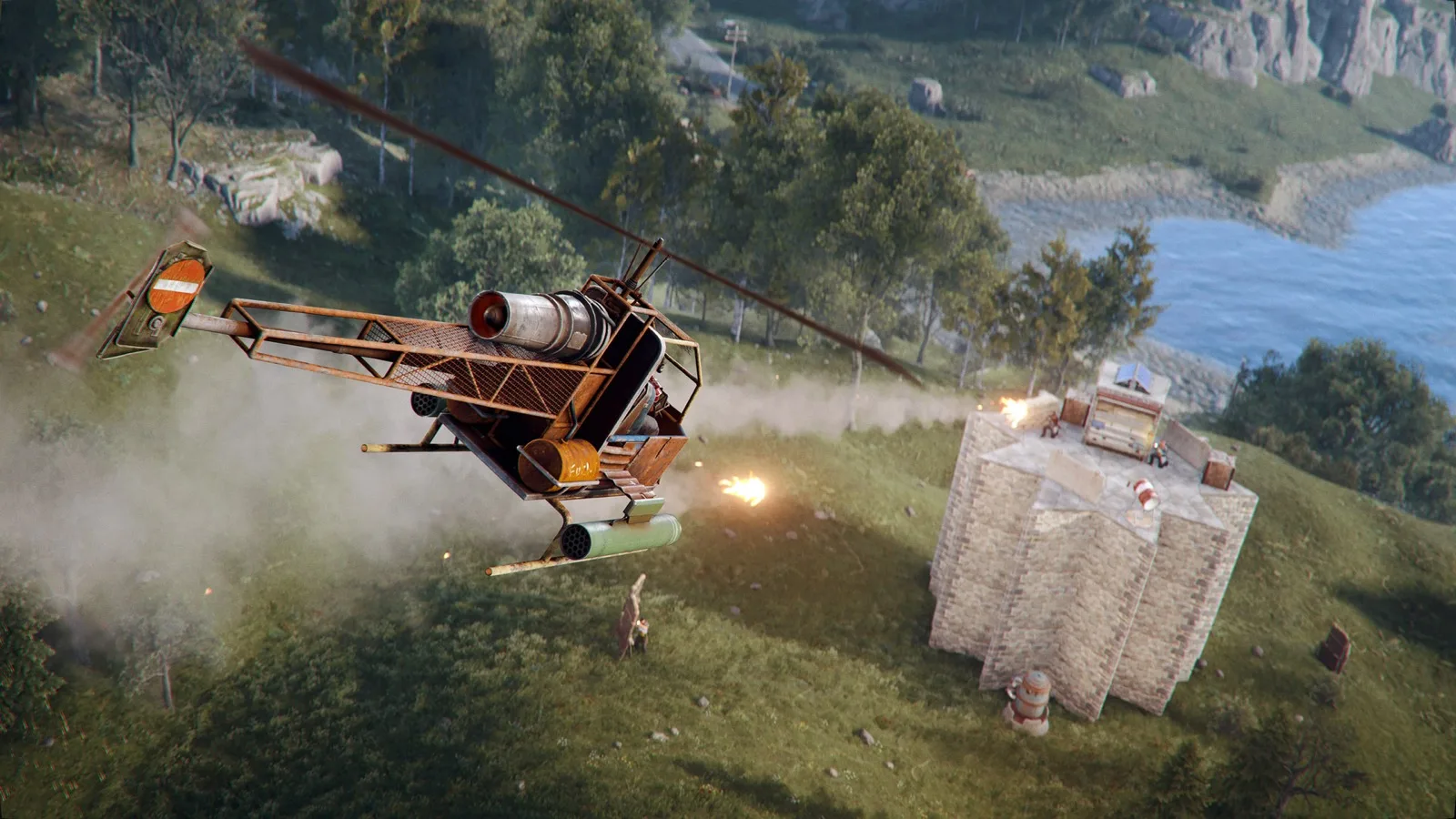
The fastest way into the air in Rust is scrap. The Air Wolf vendor at Bandit Camp sells a Hot Air Balloon for 150 scrap, a Scrap Transport Helicopter for 1,250 and an Attack Helicopter for 2,250 — and minicopters spawn free along roads if you'd rather scavenge one. Every helicopter flies on the same control scheme, so learn the minicopter and you can fly the lot.
Flying changes the game more than any other unlock. A monument run that took ten minutes on foot takes ninety seconds by air, airdrops become yours by default, and roof camping stops being your problem and starts being everyone else's. This guide covers getting your first aircraft, the actual controls, fuel planning with real numbers, and how not to donate your heli to the nearest SAM site.
Getting Your First Helicopter
You have two routes: buy or find.
Buying is the reliable one. Air Wolf at Bandit Camp sells three aircraft for scrap:
| Aircraft | Price | Comes with |
|---|---|---|
| Hot Air Balloon | 150 scrap | 75 low grade (~6 minutes of burn) |
| Scrap Transport Helicopter | 1,250 scrap | 100 low grade in a 500-capacity tank |
| Attack Helicopter | 2,250 scrap | Pilot seat plus a gunner seat with turret and rocket pods |
The minicopter is the one you don't have to buy. Minis spawn in the world along roads and open ground, usually sitting in fields or beside the tarmac with little or no fuel in the tank — and depending on the current patch, Air Wolf may stock them too (vendor inventories aren't in our datamined files, so check the counter in game). Carry 30–50 low grade on roams and any mini you stumble across is instantly yours. Early wipe, checking road stretches for a spawned mini is genuinely worth the detour; a free mini beats a 1,250-scrap purchase every time. If scrap is the bottleneck, the scrap farming guide will get you to Air Wolf money fast.
How to Fly: The Controls
All three helicopters share one paradigm: keys handle throttle and yaw, the mouse handles pitch and roll. These are the actual binds:
| Input | What it does |
|---|---|
| W (press, then hold) | Start the rotors, then climb |
| S (hold) | Descend / slow the rotors — tap for a controlled landing |
| A / D | Turn left / right (banks automatically) |
| Left Ctrl + A / D | Flat yaw, no banking |
| Mouse forward / back | Pitch nose down (accelerate) / up (brake) |
| Mouse left / right | Roll left / right |
| Hold Left Alt + Mouse | Free-look without steering |
| X | Swap seats |
| Spacebar | Dismount — works mid-flight, so mind your fingers |
The flow for a first flight: fuel the tank (E on it — it's locked while a pilot is seated, so fuel first, fly second), mount, press W once to spool the rotors, then hold W to lift. Rotors take about 7 seconds to reach full speed on every helicopter, so there's a beat between "engine on" and "actually flying" — don't panic-mash W on the pad. To move forward, push the mouse gently forward to tip the nose down; your lift becomes thrust. Pull back to brake. That nose-tilt relationship is 90% of flying — everything else is practice.
Two things kill new pilots. First, over-correcting: small mouse movements, always — the heli keeps drifting after you level out, so correct early and softly. Second, Spacebar: it dismounts you at any altitude with no confirmation. The full per-vehicle control sheets live on our controls pages.
The scrap heli flies on the same keys but is a different beast — back-heavy with a pronounced landing bounce, and once it's rolling downhill it's nearly impossible to stop, so land flat. Its cargo bay carries your whole squad, and passengers in the bay can repair and refuel mid-flight. The attack heli self-levels and is actually more forgiving than a mini; over-correcting is the main way people crash it. Both it and the scrap heli also have a shuttle-drive mode (Left Ctrl + WASD) to taxi on their wheels.
Fuel Planning: The Real Numbers
Every helicopter burns low grade fuel at 0.5 per second at throttle — that's 30 low grade a minute. So the arithmetic is simple:
- chevron_right100 low grade ≈ 3 minutes 20 seconds of hard flying
- chevron_rightA full 500 tank ≈ 16–17 minutes at full burn, longer if you cruise gently
That means the 100 low grade a scrap heli arrives with is a hop to your base, not a tour of the map. Before any real trip, do the maths: a cross-map round trip is comfortably inside 300 low grade, but running dry over water or a hot monument ends exactly how you'd expect. I keep a stack of low grade in a box by the landing pad and top up before every flight — refueling at home is free, gliding into a swamp is not.
The Hot Air Balloon plays by different rules: it only burns fuel while the burner is lit, at 1 low grade every 5 seconds, and coasting on the wind costs nothing. That's why 75 low grade (about 6 minutes of actual burn) can carry it a long way — you pulse the burner for altitude and let the wind do the work.
Landing Without Dying
Landing is where helicopters actually get destroyed. The technique: kill your forward speed first by pulling the nose up until you're hovering, then tap S in short presses to descend vertically. Committing to a moving landing is how you clip a tree at 40 and turn 750 HP of minicopter into scrap. Flat ground matters more than you think — especially for the scrap heli, which bounces on touchdown and rolls on slopes.
Where you park matters too. A minicopter left outside decays in roughly 8 hours; under a roof it lasts about 36. Build a landing pad with cover, or accept that your heli is a rental.
Durability, for planning fights and crashes: the minicopter has 750 health, the attack helicopter 850, the scrap transport heli 1,000 and the hot air balloon 1,500. None of that helps the pilot, who is exposed in the mini — a single headshot ends the flight.
Mini vs Scrap Heli vs Attack Heli: The Datamined Numbers
Every stat below comes straight from the game's vehicle data, and the pattern is clearer than the prices suggest:
| Stat | Minicopter | Attack Helicopter | Scrap Transport Heli |
|---|---|---|---|
| Health | 750 | 850 | 1,000 |
| Seats | 2 | 2 (pilot + gunner) | 2 up front + cargo bay |
| Max engine thrust | 3,000 | 8,500 | 17,500 |
| Fuel burn | 0.5/sec | 0.5/sec | 0.5/sec |
| Rotor spool-up | 7 seconds | 7 seconds | 7 seconds |
Two things jump out. First, all three burn low grade at exactly the same 0.5/sec rate — the scrap heli isn't "thirstier" per second, it just gets flown on longer group errands. Second, the thrust spread is enormous: the scrap heli's engine pushes nearly six times the force of a mini's, which is why it hauls a full cargo bay uphill while the mini wallows with two armored passengers. The attack heli sits in the middle with the most forgiving handling of the three — its extra thrust over the mini goes into stability rather than cargo. If you want the raw stat sheets, each one is on its vehicle page: minicopter, attack helicopter, scrap transport helicopter.
Repairs, Getting Shot Down, and Bailing Out
Helicopters repair like everything else in Rust: hit the airframe with a hammer while carrying resources. Do it at the pad after every sketchy flight — a heli that limped home at a sliver of health is one door-camp burst from being a crater, and you can't repair mid-firefight because recent damage blocks the repair for a moment. Remember the scrap heli's party trick here: bay passengers can repair and refuel it in flight, which is why a crewed scrap heli is so hard to bring down with small arms.
If the aircraft is dying under you anyway, there's a better option than riding it in: the Parachute. It crafts at Workbench 2 for 2 tarp, 2 sewing kits, and 50 cloth, sits in your backpack slot, and deploys with the jump key in mid-air — but only if you're at least 15 metres off the ground, and it must be repacked after each use. Spacebar out, pull, and watch your dead mini hit the deck from a safe drift. Every serious pilot flies with one; losing the heli is a scrap problem, losing the kit is a wipe problem.
And when it's someone else's heli that needs to come down: the exact explosive and ammo cost to delete each airframe is on our raid pages — minicopter, attack helicopter, scrap heli — priced from the same damage data. A hovering heli is a big, slow piñata for anyone who did the maths.
SAM Sites: The Anti-Air Problem
SAM sites are the reason you don't fly in a straight line at roof height. Launch Site's SAMs are always live and will engage any aircraft, including balloons — give the monument a wide berth or fly low and fast on the deck. Player bases run SAMs too: they draw 25 rW of power (the hungriest common component in a base circuit — see the power usage table), so a compound bristling with dishes and turrets probably has the electricity budget for anti-air. Altitude and unpredictable approaches are your defence; a hovering heli near a big base is a claimed kill.
SAMs aren't the only thing pointed up anymore, either. The Homing Missile Launcher is a shoulder-fired anti-air weapon (Workbench 2: 20 high quality metal, 3 metal pipes, tech trash, and a CCTV camera) with active guidance — the shooter has to keep tracking you with the launcher until impact, and per the item's own description the missile can be distracted by flares. That's exactly what the attack helicopter's flare button is for, and why even mini pilots should fly like someone might be locked on: change heading, change altitude, and never hover in line of sight of a base.
The Attack Helicopter: Flying Gun Platform
The attack heli is the only aircraft that shoots back, and it's a two-player machine: the pilot flies and fires rockets (Left Mouse) and flares (Right Mouse, 30-second cooldown), while the gunner presses E on the green monitor to enter a night-vision targeting screen and run the chin turret. The turret takes auto-turret-compatible guns fitted under the gunner seat, and the rocket pods only accept High Velocity and Incendiary rockets — standard rockets won't load — with a 36-rocket capacity and roughly 8 seconds between volleys. Loading rockets and fitting the turret both require the pilot seat to be empty. Solo it's an expensive taxi; with a practised gunner it's a raid tool.
One clarification, because the name trips everyone up: the Patrol Helicopter is not this. The Patrol Helicopter is the NPC gunship that circles the map hunting players — you fight it, you don't fly it. If that's what you're after, the Patrol Helicopter raid guide covers engaging it. The Attack Helicopter is the player-owned one you buy at Bandit Camp.
The Hot Air Balloon: Budget Airlines
At 150 scrap the balloon is the cheapest flight in the game, and it works nothing like a helicopter. There's no mount key — you walk into the basket — and one control: E on the red Burn button lights the burner to inflate and climb, switching itself off after about 30 seconds. You cannot steer. Direction is pure wind, and wind changes with altitude, so the skill is watching the flags on the rigging and pulsing the burner only while they point somewhere useful. It's slow, it's a 1,500-HP target for SAMs, and it decays on roughly a 3-hour timer in the world — but for a cheap one-way cargo move or an early-wipe airdrop chase, nothing else costs 150 scrap. One warning: don't stand under the basket as it lands.
Start with a found minicopter, learn the nose-tilt, and keep 30 low grade in your kit. The whole map gets smaller the day you stop walking.
Frequently Asked Questions
How do you get a helicopter in Rust?expand_more
Buy one at the Air Wolf vendor in Bandit Camp — the Hot Air Balloon costs 150 scrap, the Scrap Transport Helicopter 1,250 and the Attack Helicopter 2,250 — or find a minicopter free in the world, where they spawn along roads and open ground, usually with an empty tank. Carry some low grade fuel and any spawned mini you find is yours.
How much fuel does a minicopter use?expand_more
0.5 low grade fuel per second at throttle — 30 a minute. So 100 low grade buys about 3 minutes 20 seconds of hard flying, and a full 500 tank lasts roughly 16–17 minutes. The tank is locked while a pilot is seated, so fuel up before you mount.
How do you fly a minicopter in Rust?expand_more
Fuel the tank, mount, press W once to spool the rotors (about 7 seconds to full speed), then hold W to climb. Push the mouse forward to tip the nose down and accelerate, pull back to brake, and use A/D to turn. Land by pulling up to a hover first, then tapping S to descend vertically. Small mouse inputs — over-correcting is what crashes new pilots.
What is the attack helicopter in Rust?expand_more
A player-owned two-seat gunship sold for 2,250 scrap at Bandit Camp. The pilot flies and fires High Velocity or Incendiary rockets while the gunner operates a chin turret through a night-vision screen. It's not the Patrol Helicopter — that's the NPC boss that hunts players, which you fight rather than fly.
Do SAM sites shoot down minicopters?expand_more
Yes — SAM sites engage any player aircraft, including minicopters and hot air balloons. Launch Site's SAMs are always active, and player bases can run their own for a 25 rW power draw. Fly low and fast past defended areas, or route around them entirely. Players can also carry the Homing Missile Launcher, whose missiles track aircraft until impact but can be thrown off by flares.
Can you parachute out of a helicopter in Rust?expand_more
Yes. The Parachute crafts at Workbench 2 for 2 tarp, 2 sewing kits, and 50 cloth. Dismount with Spacebar, then press jump in mid-air to pull the cord — you need to be at least 15 metres above the ground for it to deploy, and it has to be repacked after each use. It's the standard insurance policy for anyone flying over water, SAMs, or other people's gunfire.
More Guides
50 Rust tips that hold up under pressure — spawn survival, scrap farming, base building, monument runs, PvP habits, and endgame raiding, with the tools to back each one up.
Yes, you can play Rust solo. Here's how to build hidden, avoid zergs, raid on a budget, and pick servers that don't crush you.
How to get cloth in Rust: hemp picking and farming, animal harvesting, and recycling rope, sewing kits and tarp — with real yields and a fastest-route verdict.