Rust Cars Guide: Finding, Building & Driving Modular Cars
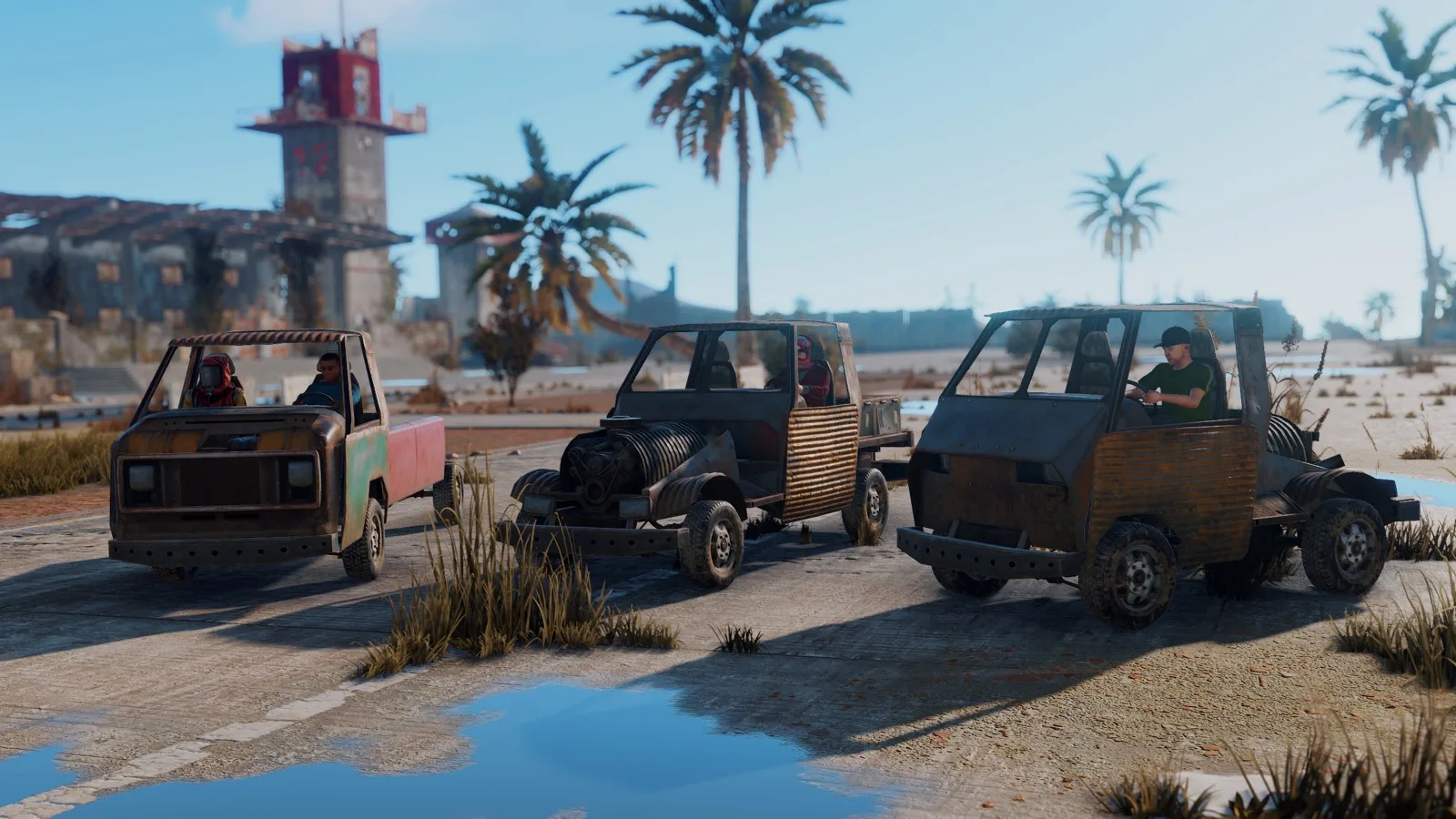
There is no "car item" in Rust. You never craft a car, you never buy a finished one — you find a bare chassis rusting at the roadside, drag it home, and build the vehicle you actually want out of modules: a cockpit here, an engine there, maybe a storage bed or an armored shell. That modular system is the whole game, and it's also why so many players give up at the first hurdle — they find a car, mash W, and nothing happens, because a found chassis is a frame, not a vehicle.
This guide is the missing manual: where cars come from, how the 2/3/4-socket chassis sizes differ, what every module and engine part costs, how the car lift workflow actually goes, locking your car, and what the fuel bill looks like. The craft costs here come straight from the game's item data — the same numbers our chassis pages carry in full.
Where Cars Spawn: Finding a Chassis
Modular cars spawn along the roads. Walk or ride any road network and you'll pass them — partially-fitted wrecks sitting on the verge, usually with a random assortment of beat-up modules already attached and sometimes a splash of fuel or even spare parts left in them. Early wipe they're everywhere; a few days in, the good ones near spawn beaches get picked clean, so check the quieter inland roads.
A found car is almost never driveable as-is. The engine is either missing or missing its internal components, and everything on it is at low condition. Your job is to get it moving just enough to limp it home — or push it, which works but is exactly as miserable as it sounds. Check the wreck's modules before committing: a chassis that already carries a cockpit-with-engine module is worth far more than a flatbed shell, because engine modules are the expensive part.
One more source worth knowing: the Junkyard monument is built around cars — its magnet crane exists to lift modular cars and feed wrecks into the shredder for resources. If you'd rather scrap cars than drive them, that's where it happens. The crane runs on low grade and its controls are modal — WASD drives the treads while Shift is held and works the arm when it isn't, which is the one trick everyone flailing at it is missing. The full scheme is on the crane controls page.
The Three Chassis Sizes
Every car is built on one of three chassis, named for how many module sockets they carry:
- chevron_right2-socket chassis — the compact. One cockpit-with-engine plus one utility module and it's complete. Cheapest to fit out, easiest to fuel, my pick for a solo runabout.
- chevron_right3-socket chassis — the sweet spot. Engine, cockpit, and a storage or passenger module, with room to balance the build.
- chevron_right4-socket chassis — the big frame. The base for armored group builds, taxis, campers, and hauling rigs, and it wants a serious engine setup to move all that weight.
A chassis has no meaningful health or seats of its own — both come entirely from the modules you fit. Armored modules raise the car's total health well beyond a bare frame, cockpit modules add the seats. That's why our vehicle pages list chassis by socket count instead of quoting an HP stat: the stat sheet of a modular car is the sum of its parts.
The Module System
Modules split into two families. Driving modules make the car go: the cockpit, the cockpit-with-engine, the standalone engine module, and the armored cockpit. Utility modules make it useful: passenger seats, rear seats, taxi and camper bodies, storage, a fuel tank, and the large flatbed, plus armored passenger variants for fighting builds.
Rather than duplicate the full price list here, the chassis pages carry every fittable module with its exact craft cost and workbench tier — see the tables on the 2-socket, 3-socket, or 4-socket pages. The pattern is simple: most modules are Workbench 2 crafts costing metal fragments plus wood, engine-bearing and armored modules add high quality metal, and armored modules are the only Workbench 3 crafts in the system. Blueprints are cheap too — every module in the item data researches for a flat 60 scrap, so unlocking your build costs less than the metal to make it.
Which Modules Are Actually Worth Fitting
Beyond the mandatory cockpit-with-engine, a few modules earn their socket and the rest are situational. What the item data says about the interesting ones:
- chevron_rightCamper — the sleeper pick, literally. A dual module that lets up to 4 players respawn in it, with a barbecue, a locker, and a small storage box built in. That's a mobile spawn point for the price of 175 metal fragments and 125 wood: park it near a raid target and your whole group respawns on wheels. Easily the most underrated module in the game.
- chevron_rightStorage — 50 metal fragments and 125 wood for a proper cargo box on your chassis. The farm-run module; one of these on a 3-socket is the classic loot hauler.
- chevron_rightTaxi — two passenger seats behind protection at the front. The name is the use case: ferrying teammates who'd rather not eat the first burst of an ambush.
- chevron_rightArmored cockpit and armored passenger — the only Workbench 3 modules, with movable metal window covers. This is what turns a car from transport into a fighting vehicle; small-arms fire that would kill everyone in an open cockpit pings off.
- chevron_rightFuel tank and large flatbed — dual modules for specialist rigs. The flatbed is a standing platform, which on the right server means a mobile gun deck.
The build logic: a 2-socket wants cockpit-with-engine plus storage. A 3-socket adds seats or armor. A 4-socket exists for the full armored taxi-camper-war-rig fantasies — just remember every module adds weight the engine has to pull.
What a minimum driveable car actually costs, from the item data:
| Piece | Craft cost | Workbench |
|---|---|---|
| Chassis (2-socket) | Found on the road — not craftable | — |
| Cockpit With Engine Module | 150 metal fragments + 5 HQM + 100 wood | T2 |
| Carburetor | 100 metal fragments | T2 |
| Crankshaft | 70 metal fragments | T2 |
| Pistons | 70 metal fragments | T2 |
| Spark Plugs | 70 metal fragments | T2 |
| Valves | 70 metal fragments | T2 |
| Modular Car Lift | 200 metal fragments + 5 HQM + 1 gears | T2 |
Add it up and a from-scratch first car runs 730 metal fragments, 10 high quality metal, 100 wood, and a set of gears — lift included — all at Workbench 2. If your found chassis already has usable modules, you're only paying for what's missing.
Engine Internals: Why Your Car Won't Start
This is the step that stalls most people. An engine module is a housing, and it will not run until every internal component slot is filled: carburetor, crankshaft, pistons, spark plugs, and valves. Miss one and the car is furniture. Each component also has a condition bar — parts pulled from roadside wrecks are usually half-dead, and component quality affects how well the engine performs, so crafting fresh parts beats scavenged ones.
All five components craft at Workbench 2 for metal fragments alone (the exact numbers are in the table above, and in the engine components table on every chassis page), and each blueprint researches for a token 15 scrap. At 380 fragments for a full set, a complete engine is cheaper than most players assume — the cost was never the problem, knowing the checklist was.
Components live inside the engine module and are fitted with the car on a lift. Better parts, better performance; a full set of fresh ones, and the engine turns over.
The Car Lift Workflow
The Modular Car Lift is the workstation of the whole system — the item description says it plainly: it's what lets you modify modular vehicles. It costs 200 metal fragments, 5 high quality metal, and 1 gears at Workbench 2 (or a 60-scrap research if you find one), and it needs electricity — a 5 rW draw in the game's power data, one of the cheapest powered deployables in a base circuit (see the power usage table). A single small battery setup runs it fine. It also wants ceiling clearance, so plan a garage bay rather than squeezing it into a 2x1.
The workflow, once a car is on the lift:
- chevron_rightStrip and rearrange modules. Add, remove, and reorder modules across the chassis sockets. This is where a roadside wreck becomes your build.
- chevron_rightOpen the engine and fit internals. Slot the carburetor, crankshaft, pistons, spark plugs, and valves into each engine module.
- chevron_rightRepair everything. Modules and components come off the road in rough shape; the lift is where you bring condition back up.
- chevron_rightAdd a lock. Cars are lockable, and the lift is where it happens — more below.
Drive the car onto the lift (or push it, for a dead one), do your work, drive it off. Any time the car needs surgery — swapped modules, fresh parts, repairs after an argument with a rock — it goes back on the lift.
Locks and Keys
Yes, you can lock a car — and on a busy road you absolutely should, because an unlocked car with fuel in it is public transport. Car locking runs on its own system, separate from the key locks and code locks you bolt to doors: with the car on your lift you fit it with a lock and craft keys for it. Anyone without a key can't drive off in it, and you can cut spare keys for teammates so the whole group shares the car.
Keys are per-car, so label your storage — a box of unlabeled car keys three wipes deep is its own kind of puzzle. And a lock protects the driver's seat, not the paintwork: a locked car can still be shot, rammed, and stripped by anyone with enough explosives, so garage it behind doors when you log off. Treat the lock as theft insurance, not a force field.
Driving: The Part Nobody Warns You About
Actually driving the thing is its own small skill. You mount with E like any vehicle, steer with WASD, and dismount with Spacebar — ideally while stationary, because Spacebar doesn't check your speed any more than it does in a helicopter. A few learned-the-hard-way rules:
- chevron_rightStay on the roads. Modular cars are road vehicles in a game that is mostly not road. Off-road they lose speed, fight the terrain, and find every rock that can beach a chassis. The road network is the car's habitat; treat cross-country as an emergency manoeuvre, not a route.
- chevron_rightThe car is a weapon, and also a victim. Hitting players and animals at speed hurts them badly — a car is genuinely one of the better roadkill tools in the game — but collisions damage your modules too, and a wall doesn't care how fast you were going. Every hard impact is future lift time.
- chevron_rightWatch your engine's condition. Performance degrades with the parts, so a car that leaves the base crisp can come home sluggish after a firefight put bullets through the engine bay. Shots into the engine module are the standard way roam gangs stop a car — armored builds exist precisely because of it.
- chevron_rightMomentum is your armor. An armored car that keeps moving through an ambush usually lives. The moment you stop to fight from the seats, you're a parked loot box. Drive through, turn around out of range, and make them commit.
Fuel: What Driving Costs
Cars run on Low Grade Fuel, same as boats and helicopters. The baseline recipe turns 3 animal fat + 1 cloth into 4 low grade, which prices a tank in roadkill — and the low grade fuel guide covers the faster bulk routes, including crude oil refining, when you're fueling a group's motor pool.
How fast a car drinks depends on the build: how many engine modules you're running, the condition and quality of the internals, and how much chassis you're hauling. A light 2-socket runabout sips; a 4-socket armored rig with a big engine setup is the thirstiest thing on land. The practical rule is to fuel the car for the trip, not the wipe — fuel left in an unattended car is a donation to whoever finds it first.
Cars vs Horses vs Helicopters
Where do cars actually fit? Honest answer: in the middle, and that's a real niche.
Take a horse when you're solo, early, or off-road. A horse costs nothing to run, handles terrain a chassis can't, and doesn't announce you to the whole grid. Early wipe, before Workbench 2, a horse beats a car on every axis except cargo.
Take the car when you're moving people and loot along roads. Nothing else hauls a full group plus storage boxes overland, an armored build shrugs off small arms that would kill horse or rider, and cars are far cheaper to replace than any aircraft. Farm runs, recycler loops, moving base — road trips are car trips.
Take a heli when the destination matters more than the cargo. A minicopter ignores roads, rivers, and river-camping neighbors entirely, and for pure speed to a monument nothing on wheels competes — at the price of low grade burn and SAM sites. The flying guide covers that side, and the boats guide does the same for water.
The car's quiet superpower is logistics. It isn't the fastest and it isn't the cheapest, but it's the only vehicle that moves your whole squad, their gear, and a farm haul in one trip without touching the fuel bill of a scrap heli.
Frequently Asked Questions
How do you get a car in Rust?expand_more
You find one, not craft one. Bare and partially-fitted chassis spawn along the roads — walk any road network and check the wrecks on the verge. A found car usually won't drive until you fit and repair its modules and engine parts, so get it to a Modular Car Lift, fill out the engine, and it's yours. The chassis itself is the one piece of the car you can't craft.
How do you make a car engine work in Rust?expand_more
Fill every component slot. An engine module needs all five internals fitted before it will start: a carburetor, crankshaft, pistons, spark plugs, and valves, each craftable at Workbench 2 for metal fragments (380 total for the set). Fit them with the car on a car lift, make sure there's low grade fuel in the tank, and check component condition — worn scavenged parts hurt performance, and a missing one means the engine simply won't run.
How much does a car lift cost?expand_more
200 metal fragments, 5 high quality metal, and 1 gears, crafted at Workbench 2. It needs power and room to place, so build it into a proper garage bay. It's the one piece of infrastructure the whole modular car system depends on — module swaps, engine internals, repairs, and car locks all happen on the lift.
Can you lock a car in Rust?expand_more
Yes. With the car on a car lift you can fit it with a lock and craft keys, and anyone without a key can't drive it. You can craft spares so your whole team shares one car. The lock stops joyriders, not raiders — a locked car can still be destroyed — so park it behind base doors when you're offline.
Can you respawn in a car in Rust?expand_more
Yes — that's the Camper module's whole trick. It's a dual module (175 metal fragments + 125 wood at Workbench 2) that lets up to 4 players respawn in it, and it packs a barbecue, a locker, and a small storage box. Fit one to a 3- or 4-socket chassis and you've got a mobile spawn point for raids and deep roams — the closest thing Rust has to a camper van, because it is one. A car in Rust is a project, not a pickup — and that's exactly why most of the server never has one. Grab a roadside chassis early, spend the 730 frags to make it real, put a lock on it, and you've got the best loot-hauler in the game while everyone else is still walking. Full module and engine part tables live on the [chassis pages](/vehicles/modular-car-2-socket/), and the [vehicles hub](/vehicles/) covers everything else with an engine.
More Guides
50 Rust tips that hold up under pressure — spawn survival, scrap farming, base building, monument runs, PvP habits, and endgame raiding, with the tools to back each one up.
Yes, you can play Rust solo. Here's how to build hidden, avoid zergs, raid on a budget, and pick servers that don't crush you.
How to get cloth in Rust: hemp picking and farming, animal harvesting, and recycling rope, sewing kits and tarp — with real yields and a fastest-route verdict.